new book about working with MJ during HIStory

Chapter 32 continued.

DB writes about the TDCAU video where the focus on 'South American poverty' counteracted the earlier issues of anti-Semitism surrounding the song. He concludes the songs reception was 'modest and fading' entering at number 30 in the US charts, while entering the top 10 in European charts. DB quotes Frank Ceraolo from the labels promotion team, he reflects how there was 'pressure' to 'deliver' club records when the album wasn't club records leaning. He remembers that this was difficult enough to do with Scream, then there were songs like ES, SIM and TDCAU. He claims the remixes of YANA and ES successfully achieved this effect. He reflects how MJ trusted him to deliver on remixes and suspects MJ was very 'hands off' when it came to remixes due to MJs own lack of knowledge and experience of club music experiences since Studio 54.

DB writes that his mother 'quietly' passed away 3 months after his father's death. This led to a big perspective shift for DB on how much his work impacted his life and whether it was worth it. He had heard himself referenced as 'the machine' by his colleagues due to his approach to his work. He attended his mother's funeral and recalled her own fears about him searching 'a desperate dream' that would lead him and her heartbroken. And how his pursuit of that dream was probably an effort to counteract her fears. He found himself pondering on his mother's tireless efforts on her children.

Companies from the international label were confident in continuing the campaign for History, partly due to the tour announcement. Due to pressure from these counterparts, the label released SIM video with Nick Brandt. MJ was busy pursuing the Ghosts video, while DG and DB 'lamented the lack of direction'. DB bought Steve Einczig to oversee the project with him. SE had worked on OTW and was familiar with MJ, DB fondly remembers how SE referred to MJ as 'the kid' in their private conversations.

To be continued.
 
Last edited:
Chapter 32 continued.

DB writes how MJ was 'over the top with excitement' with Stan Winston as the director for Ghosts. DB and SE met with SW at his workshop and were extremely impressed with SW special effects work on major films, he describes SW as 'intense' but 'likeable'. He suggests that SW was happy to have a shot as a Director as opposed to being the 'special effects guy', as SW told DB a story about how the special effects work was to supplement his income but ended up being his life's work. DB claims the special effect work SW planned for Ghosts was surpassed in number by what he planned for Jurassic Park. DB failed to see the relevance of the Ghosts video to album sales or future product sales and compares it to the uncomfortable place the History Teaser occupied. SW gave DB and SE little information regarding the music as it was MJs territory and 'told us not to be concerned about film business issues'.

DB recalls that Sony's contribution to the project was limited to $1,000, 000, so there was little risk for the label. Yet, he questioned why the label allowed MJ to get so indebted, and summarises that the Beatles catalogue was enough of a reason 'to stay in business with Michael Jackson'. SE oversaw the Ghost production while DB worked on another hit for Pearl Jam which led to 'challenging priority at Epic'.

By August 1996, another family tragedy took place as DBs mother in law passed away very unexpectedly following a sudden stroke. He reflects back at how he 'downplayed' the succession of 3 close family deaths although he continued to 'question life's direction'.

SW invited DG, SS and SE to view the Ghosts film, they were impressed but still puzzled about it's marketing angle. The production costs rose to $16,000,000. MJ called DB to request if the the film could be shown in Loews theatres in time for Halloween. This 'grand plan' appeared to tip DB over the edge, after describing the scenario as 'nuts', 'madness' and 'crazy' he writes 'I can't do this anymore!'. DB informed DG about the theatre request, DG was also puzzled by it and asked SG about the reason for this and was told 'Because Michael wants it'. DB contacted Robert Kardashian again.

To be continued.
 
Last edited:
Chapter 32 continued.

Not long afterwards DB received a call from an acquaintance working for Virgin records, and asked if DB would be interested in being president of this new company. DB details Richard Branson's successes. He had a long dinner meeting with RB who assured DB the label would be small and solely focused on the music. Soon after, DB was given an inscribed watch from TM for his 20 years of service, SE was also given one for 25 years of service at an employee service awards event, although he was the only one to know that he was intending to leave at this point. He told DG of his resignation over breakfast, who expressed genuine happiness for DBs opportunity. They both reflected on their time working with MJ, DG informed DB that he'd had a meeting with an Sony exec from Europe and they had a plan to release a remix album and sort MJs image issues. DB remarks on his own naive impressions of thinking such issues could be resolved. He felt bad that DG was stuck in the 'madness' but realised that he was finally 'free'.

Chapter 32 finished 🎉

I hated this chapter, there's no other way to put it.
I liked the parts where DB wrote about his own personal tragedies, because it's these experiences that help build bridges between our individual stories, I was hugely disappointed that DB didn't give MJ that chance through his story telling.

I think it's clear that DB is having little to do with MJ at this point, and any chapter where MJ is not referenced through personal interactions do not reflect well on MJ. This combined with the fact that DB was facing several personal tragedies really gave the feeling that DB was done, and anything MJ was a waste of time.

I was genuinely disgusted at DBs attitude to the HBO incident. He claims he heard reports MJ was unwell, he himself saw an unwell MJ, had even engaged in a meeting with DG about what to do if MJ doesn't pull through, then even suggests an ambulance was arranged at the ready and yet appears totally blindsided by MJs collapse, they all were. LL initial response was to state that she/he offered MJ water and it wasn't their fault MJ refused it. All I could see was a re run of TII. MJ was clearly unwell, but those around him were treating MJs ill health as an inconvenience rather than being concerned for his wellbeing. DB quotes JG and the other assistant reflecting how all their hard work had gone to waste, there was no concern expressed for MJ at all. DB writes how it needed to be a life or death situation for MJ to cancel, and the impression I got was that being ill and collapsing wasn't a good enough reason, it's almost like his poor health was this huge inconvenience for them all. Can you imagine a colleague collapsing at work, and everyone else being concerned that they can't get on with their work now and how their work has now gone to waste, and how they offered them water so it wasn't their fault the ill colleague collapsed??? I couldn't believe how tone deaf they all were. I can't understand how DB could write it like this after everything we found out about TII. DB was right though, it took his death for people to take MJs health with any modicum of seriousness. And it really seems like the HBO incident was MJs lucky escape from what happened in TII. The fact that DB was buying newspapers to get info on MJs health after the incident was also very telling.

I really disliked how DB totally glossed over the Britt Awards incident, and even referenced JC criticism of MJs christ like behaviour, when we all know JC did his thing before that part of MJs performance that is criticised for christ-like behaviour. DB shared no views on the incident, relating it like an average everyday event. While he relates the UKs positive media coverage of JC, he echoes their sentiments through his refusal to acknowledge the incident as problematic as it was. I just get the sense that no one cared if it involved MJs feeling/reputation. Like he was a cartoon character that you could run over and suffer no consequences. I expect this angle from the media, but I find it shocking that those he worked with closely also treated him this way.

DB praises how other acts were centred on music, but MJs life was always a circus act, and references the LMP divorce. A divorce is one of the most painful things people go through, and one that many people experience, but as usual MJ is denied any sense of his own humanity, something as personal and painful as a divorce had to be a circus act for MJ because it was MJ going through it. Could you imagine publicly calling someone elses divorce a circus act? This again suggests DB thought the marriage was a sham.

There is also the sense the US label no longer cared for MJ as he wasn't pulling in the figures for them, there's this sense of superiority, that it was irrelevant that MJ was pulling figures elsewhere in the world. I did find the comment about the Beatles catalogue interesting.

Of course, it is important to bear in mind that DBs grief likely heavily influenced how he remembered this time period.
 
Last edited:
Chapter 33, the final chapter was about DB life after leaving the label and how he viewed MJs life from the outside.

DB begins this chapter claiming that he never saw MJ again. But he reflected on how the 'darkness', 'pressure', 'intensity' and 'challenges' of working with MJ never left him, he questions if anyone, including MJ himself could've handled the MJ life. He reflects how MJ dedicated himself to pursuing what was 'bigger and better' but it was just an illusion he had managed to keep 'perpetuating'. He wrote how MJ experienced unparalleled fame, but that 'fame and image were all he knew' and he clung to them in desperation within a 'two decade fall in the global eye'.

DB comments how he chose to no longer participate in the 'tragic struggle' of keeping MJs 'career relevant' and how it never really recovered again. However, DB experienced relief and an easier life after exiting the MJ world. However, not long afterwards, DB experienced hearing problems which effected his daily interactions. After an audiologist diagnosed DB with midrange hearing loss, DB made the difficult decision to step back from his work. He remembers the 'crushing' realisation of having to wear hearing aids at 49 years old. He writes that although this was a hard time for him and there was a huge salary cut, the benefit was that he was able to spend time with his children while they were still young and this was 'priceless' to him. It made him realise how his competence at his work had meant he had neglected to gain skills in the home area, while his wife beared the load by being 'super mom'. Although there was an inevitable adjustment period as he settled into a new way of life, attending all his children's events made him see his children as his 'heroes'. In 2004, DB took a marketing job for book and film companies at a place called Big Huncho Media. He recalls doing exciting projects for Harry Potter and Twilight.

DB writes that MJs chaotic life with it's high peaks and extreme troughs 'continued with frightening velocity'. He writes about BOTDF as a remix album that sold over 6 million, but that image issues, tabloid attacks and even talk of rehab prevented MJ from reaching 'loftier numbers' of the past. He remembers how MJ started a 'family in his unusual way' which only gave critics more ammunition, and the birth of his first child with his second wife was met with 'eye rolling'. DB notes MJ had a second child with Debbie, and a third child via surrogate, and appeared to be 'settling into being a family man'. He writes about the baby dangling incident 'detonating another explosion of media headlines'. Following this, MJ covered his children's faces with veils and masks in public which was perceived as 'wierd'. DB would occasionally hear 'word' of MJs joy at experiencing fatherhood, and this seemed the most 'true and natural' aspect of MJs life from what DB experienced of MJs life.

Chapter 33 to be continued.
 
Chapter 33 continued.

DB notes how MJ had a huge turnaround of managers and PR people, that there were no Frank Dileos, Sandy Galins and Jim Morriseys anymore, but that one old associate had weathered the storm in the form of John Branca, who DB thinks protected MJs 'dwindling assets', and comments his own lack of surprise to hearing news of MJs financial issues. DB writes how the negotiations for the ATV catalogue was likely responsible for keeping MJ afloat financially. During a discussion with DG before leaving Epic, DB had predicted MJ would be bankrupt within a 6 year period, as he couldn't rely on sponsorships and touring was 'flagging' too as the times were changing. DB remarks how yet MJ managed to remain 'solvent'.

DB writes that he found the tabloid stories difficult to digest, and would occasionally find himself informing JB that he was available to help when he saw a marketing effort nose dive, JB 'graciously responded' that he would appreciate DBs input. However, in 'saner moments', DB realised there was no part time involvement in MJs world, it was always full throttle and it wasn't something he could fully commit to again. DB notes the second molestation accusation and the trial which acquitted MJ on all counts. He remembers MJ leaving the court house 'victorious' acknowledging his fans with a wave behind an umbrella, and admits it was 'painful to watch his life unravel'. He recalled all of MJs creative achievements, his kindness, generosity and the joy he bought others and questioned how it all deteriorated 'dramatically' and became so 'spectacularly bizarre'. He notes that he couldn't 'fathom' that MJ 'could commit the despicable crimes'.

DB reflects on the MJ he knew, one who had negative traits of being stubborn and could 'fib' occasionally when required, but one who 'had a certain core of honour', which DB experienced after testing this core at times and found MJ unwavering in it. He questioned whether a combination of MJs 'naievity' and social awkwardness had led MJ to his legal issues. He concludes by questioning how well he knew MJ anyway. Seeing the trial unfold reminded DB that he was a tiny cog in the MJ world for 'a brief time', that as intense as his working relationship had been, MJs life was full of such working relationships, and MJ was accustomed to working with the best.

Chapter 33 to be continued.
 
Chapter 33 continued.

DB writes that MJs death had been a surprise to him. He found himself remembering Larry Stessels words, about MJ dying young, likely through suicide when he found himself no longer relevant, but DB didn't find this plausible after MJ became a father. But he surmises that 'the way he abused his body' in preparation for the concert after History hinted at 'an early demise'. DB comments on how the first 10 shows in London were to be followed by further shows across the globe. However, the London dates increased to 50 when 'more than one million tickets were sold under two hours'. LS had heard from the likes of Kenny Ortega and 'others' that MJ was 'drugged out' during rehearsals. DB goes on to quote LS claiming that the crew were 'shocked' MJ could stand due to his drug intake, and that it was exasperated by MJs own fears over his 'comeback' and how the public would receive him.

DB was unaware of any of this during the time but thought MJs death was 'sadly predictable', and he himself had been doubtful that MJ could commit to the 'grueling tour'. He writes how he would've bet his house that MJ wouldn't have managed more than 3 shows. He recalls MJ concerts being an 'athletic event' that few performers could 'physically manage'. Aside from the physical aspects of the tour, DB found himself questioning how MJ would handle the emotional strain while touring, while working on an album 'he couldn't seem to finish' and at a real risk of losing Neverland. DB questions if MJ had felt 'forced' to complete this tour and wonders who was behind it, speculating on the banks and suits.

DB writes that on 25 June 2009 DB was meeting his son who was preparing for an internship at Sony. While working in his office, DB noticed a headline on CNN, and a helicopter shot of the gate where MJ was living. DB turned up the sound but suspected the news would be 'grim'. He suspected MJ had made himself sick to get out of the concerts just as he suspected MJ had done for the HBO special. But he notes that he would never have speculated that MJ 'had any intent to bring about his own end'.

DB remembers the news getting worse and finally broke free of the news at 6pm when his son arrived. They went to a sports bar, he asked the waiter to put one of the channels onto CNN. DB wanted to give his attention to his son as he didn't get to see him that often, and then it was announced that MJ 'was dead at the age of 50'. DB felt shocked and marked the irony that MJ was still impacting his personal life even in his death. While with his son, DB pretended the news hadn't bothered him but his conversation felt 'unnatural'. He reflected how MJs life had been taken over by tabloids and how his kids may have viewed MJ as a 'weird guy' their dad worked with as they had not experienced MJs glory years.


DB remembers receiving many calls asking if he was intending to attend the funeral in LA, he suspected the 'clamouring' to get on this guest list would have been 'obscene' and he 'wanted no part of it'. Instead he watched the funeral at home in the same place he used to take MJs calls. He found himself thinking of two people, the superstar, and the 'gentle, up eat guy'. He felt 'deeply sorry' for MJs kids and comments how they 'inherited a media frenzy' that would impact their life. Reflecting on his 'pain and sadness', DB recognised that similarly to himself, MJ too thought of his own kids as his heroes, and they gave him joy that none of his other successes could provide, as they gave him a 'taste of normalcy' and he was acutely aware of 'how elusive it is'.

Book finished🎉

My commentary:

This was obviously a sad chapter. The comment about KO reporting how badly MJ was affected by drug use was very telling. LS comments were very revealing too. However, in both of these examples there is a generic reference to drug use, this makes it look as though MJ was abusing his body as he couldn't deal with the pressures of the tour. But MJ wasn't using drugs recreationally, and it would be easy to arrive at this conclusion from the way DB presents the information. The vital piece DB was missing was that MJ had died from propofol being incorrectly administered to MJ for sleep. That MJ was preparing for a grueling tour without sleep was completely left out. Considering DB wrote about so many middle of the night calls, I'm surprised he didn't touch on this at all. Also interesting how DB emphasizes on two occasions that he didn't think MJ would have committed suicide. Also noteworthy how DB portrays JB in a good light in this chapter.

I again found myself mad at DB for suggesting MJ was just trying to get out of the concerts as he did for HBO. Even as MJ died preparing for a concert he still cannot bring himself to think maybe MJ had been legitimately sick during the HBO special incident, it seems too far a stretch for DB.

DB presents an overwhelming tone of MJs life taking a steep nose dive at the end, but gives no credit to MJ for the success of the tour sales. Yes, MJ had challenges, but he wasn't just a 'weird guy' that disappeared into obscurity, he was still surpassing records and generating interest because people wanted to see him perform. I felt DB was only interested in painting MJ as a has been, except no other has been had managed to sell that many dates at a single location. I can understand that it can be argued that MJ was at his least popular at the time of his passing, but even at his least popular he was breaking records for sellout tours. That's not something to be overlooked. Once again, I find DB echoing media narratives. But I was glad to see DB acknowledge that MJ may have been forced to do the concerts.

I also found it interesting how DB watched the funeral alone, he seemed to not want to share his sadness with his family, almost like he was embarrassed at his connection to MJ. DB wrote about the MJ news distracting him from his time with his son, as if MJs death was an inconvenience to him. The world lost a legend, it was ok to stop to acknowledge that. That is what most of the world did. I also sensed a real lack of empathy/compassion for MJ as DB wrote about his death, but this has been a consistent pattern with DB whenever MJ was going through a difficult period.

I liked how the book started in a similar way to how it ended, with DB at the edges of the MJ world, outside looking in.
 
Last edited:
So would I recommend this book to others?

I think a non fan reader would have all their previous tabloid assumptions about MJ confirmed, but they would come away viewing MJ as a sweet, crazy genius, who was highly creative and charmingly enthusiastic but somewhat delusional. Where MJ interactions are mentioned, MJ comes across objectively well. Where MJ interactions are not mentioned and the reader is relying on DBs narratives/assumptions, MJ comes across as objectively crazy. I can imagine a non fan thinking that if someone who worked so closely to MJ felt these things, the tabloids were right all along. A non fan reader may also be unaware how DBs carefully worded narratives mislead the reader.

I think an MJ fan reader will have their heart somewhat broken if they are a History era fan, but will enjoy all the additional information DB shares from his experiences, and I think it's worth reading the book for these additional insights. The MJ interactions that DB mentions will confirm all the ideas fans have of MJ already. Where MJs interactions are not mentioned, fans will come face to face with all the tired media narratives. Fans will likely notice some inconsistencies and how all blame is conveniently directed at MJ, and the label comes across as the help MJ manages to keep thwarting. Fans may also notice how MJ appeared to be very disconnected with public perceptions at times and got in his own way.

For me personally, reading this book helped me realise MJ was always f****d. As a fan, I sometimes think how things would have been if MJ hadn't passed, and wonder if MJ would've had the happy ending he deserved after the difficulties of his last decade.

Sadly, this book showed me time and again that MJ was functioning in a highly organized and unhealthy eco system specifically designed to exploit him. And as it was the only world MJ knew, he would never have experienced anything different. People only pretended to care about him for their personal gain, and worryingly MJ appeared to blindly trust them all. Even DB admitted that he would go out of his way to do nice things for MJ so he could have the power of influence over him. It wasn't that MJ surrounded himself with yes people, it's that yes people was all there was, he was a single rose in a vast field of parasitic weeds, he was never going to win. It's a miracle MJ survived 50 years in an environment like that to begin with.

I work with children, and theres something referred to as adverse childhood experiences, and research suggests that the more adverse experiences the child experiences (eg, abuse, alcoholic parent, poverty etc.) the more the chances are stacked against the child to access a good life as an adult, essentially their circumstances are rigged against them. (That's not to say that such children do not go on to have healthy lives as adults but that there are additional challenges they must overcome, and they likely may not have access to the support to help them with this). That's how I felt after completing this book, that the system was rigged against MJ, not just as a child, but his whole life. That's not to absolve MJ from some of his own daft choices, but this book has freed me from thinking there was ever a different outcome for MJ. I can see why LMP felt the need to save him, and ultimately felt it was futile.
 
Last edited:
Thank you very much for the summary, Jasmine! Must have taken you a couple of hours and lots of perseverance to keep on going.

Its an interesting perspective of the MJ world, especially the duality of DB perceiving MJ as a great guy in person and as a weirdo from afar. That shows to me how easy it is to get caught up in the weirdness not of MJ himself, but the system (involuntarily) built around him over the years, amplified by (tabloid) media.
Sad to see how easily exploitable that MJ system was for bad actors, both due to MJs own flaws and the characteristics of that system.

How could MJ have escaped that madness? I think from the outside it might sound trivial. For example he could have stayed in Ireland, sold off Neverland for a smaller and sustainable mansion, sold off his Sony catalogue and lived off the royalties from his Mijac catalogue in peace.
But it seems MJ himself was dependent of his system, as he did not have experienced anything different. He was emotionally dependent of record sales, positive media, fan reactions and took them as being accepted as a human. And he had a big ego and did not want to sell his assets, which in hindsight seemed to act more as a prison ball - as MJ used to defend them with vigor - than "just" an investment.

tl;dr: MJ was a nice guy in a weird world?

Your summaries are keeping me thinking, so thanks again, Jasmine :)
 
The great thing about the book is that it never feels like anecdotes were exagerated to make them "sexier" to a publisher. Everything sounds completely believable, because it's not over-the-top, like it would have been had it been ghost-written or bought by a big-name publisher, because then you need to appeal to lowest-common denominator readers and journalists.

The only anecdote in the whole book where I felt a veneer of exageration or maybe misremembering was MJ "trashing" the studio when he was forced to re-record the vocals for TDCAU. Not saying it didn't happen, but that was the kind of story that would feel "enhanced" in other, similar books.
 
Something else that is interesting about the book is that Sony arguably spent TOO MUCH money on MJ for the HIStory project, meaning that they still believed in him, financially, to an extent that didn't make sense in the market. So that puts into perspective maybe why they didn't promote Invincible to the extent MJ expected.
 
Thank you for this Jasmine! It was an interesting read and also shines some light on the struggles MJ endured later in life, as you can read about his stubborn persona, which made him so succesful at first but eventually left the door open (literally!) for more accusations..
 
Thank you to all for all the likes and kind messages. It's been a really positive experience for me to finally share this kind of stuff with people who likewise care about it, fellow MJ fans 🙂

Its an interesting perspective of the MJ world, especially the duality of DB perceiving MJ as a great guy in person and as a weirdo from afar. That shows to me how easy it is to get caught up in the weirdness not of MJ himself, but the system (involuntarily) built around him over the years, amplified by (tabloid) media.
Sad to see how easily exploitable that MJ system was for bad actors, both due to MJs own flaws and the characteristics of that system.

I love how you summarised this duality.

How could MJ have escaped that madness? I think from the outside it might sound trivial. For example he could have stayed in Ireland, sold off Neverland for a smaller and sustainable mansion, sold off his Sony catalogue and lived off the royalties from his Mijac catalogue in peace.
But it seems MJ himself was dependent of his system, as he did not have experienced anything different. He was emotionally dependent of record sales, positive media, fan reactions and took them as being accepted as a human. And he had a big ego and did not want to sell his assets, which in hindsight seemed to act more as a prison ball - as MJ used to defend them with vigor - than "just" an investment.
I'd like to think MJ could've just escaped and led a quiet life, but I'm not sure whether that was ever realistic or even feasible. I remember the fan and media expectations from that time, we were all waiting for him to release something. Would we all have just left him alone if he hadn't? I think retrospectively fans from that time period would like to think we would have, but I think the truth is had MJ fallen ill and cancelled the TII concerts instead of dying, his own people surrounding him would never have believed him (as demonstrated by DB) let alone a world that was deeply anticipating him.

I think one of the reasons MJs life remains so elusive is because we are using our own metrics of age related markers/expectations/experiences onto someone who never experienced the same metrics for the same things. I think the reference points never really line up for anything, such as his relationship to work, family, friends, school, money, women and etc. And I think we are in danger of doing a huge disservice to MJ when we try to interpret his complex life through the lens that makes most sense to us.

I also think my own experiences of working with children influences how I view this. I sometimes work with children who have a very warped view of the world due to the experiences they have had with only a short few years on the planet. There's a lot of work that is involved in undoing some of this warped view, to the point where sadly, I know some children are beyond the help that is available to them. Those unhealthy patterns are sometimes deeply ingrained survival skills and not an active choice they are even aware they are making. I cannot begin to imagine what it would take for someone who spent their entire life living and thriving in an extremely exploitative environment to begin to separate themselves from it.

Really enjoying the discussion though.
 
Last edited:
Thank you to all for all the likes and kind messages. It's been a really positive experience for me to finally share this kind of stuff with people who likewise care about it, fellow MJ fans 🙂


I'd like to think MJ could've just escaped and led a quiet life, but I'm not sure whether that was ever realistic or even feasible. I remember the fan and media expectations from that time, we were all waiting for him to release something. Would we all have just left him alone if he hadn't? I think retrospectively fans from that time period would like to think we would have, but I think the truth is had MJ fallen ill and cancelled the TII concerts instead of dying, his own people surrounding him would never have believed him (as demonstrated by DB) let alone a world that was deeply anticipating him.
Thats a good point. It seems that even back in 95 many people were expecting MJ to back out of the HBO concerts by faking sickness because they thought he wouldnt want to to them. He already had a reputation of not being especially reliable if the didnt wanna do things (and to an extent, I think this was true, especially during the Invincible era).
How would the media, the world and fans reacted if MJ stayed in Ireland in 2007 and "retired" there? Hard to say, maybe the media would have lost interest if he didnt start new projects.
How would they have reacted if MJ canceled the already announced TII tour in 2009? I think it would have been a medial bloodbath and even many fans would have been deeply disappointed. And Im sure MJ knew that, which surely was one factor of his sleepless nights.

I think one of the reasons MJs life remains so elusive is because we are using our own metrics of age related markers/expectations/experiences onto someone who never experienced the same metrics for the same things. I think the reference points never really line up for anything, such as his relationship to work, family, friends, school, money, women and etc. And I think we are in danger of doing a huge disservice to MJ when we try to interpret his complex life through the lens that makes most sense to us.

I also think my own experiences of working with children influences how I view this. I sometimes work with children who have a very warped view of the world due to the experiences they have had with only a short few years on the planet. There's a lot of work that is involved in undoing some of this warped view, to the point where sadly, I know some children are beyond the help that is available to them. Those unhealthy patterns are sometimes deeply ingrained survival skills and not an active choice they are even aware they are making. I cannot begin to imagine what it would take for someone who spent their entire life living and thriving in an extremely exploitative environment to begin to separate themselves from it.

Completely agree. Coincidentally, I also work with children in a therapeutic living group (dont know how thats called in English) that cant be with their parents because of many different reasons (sometimes domestic abuse or neglect). The children adapt behaviors that may have been somewhat useful in their dysfunctional lifes in the past. But they may get huge problems in the "normal world" if they cant change their set of behavior and beliefs. For MJ, the functional behaviors in his childhood were performing and doing it perfectly = maybe getting praise from his family, not getting beat up by his dad. That may be one explanation why MJ even as an adult mistook praise for performances of his shows and record sales for feeling loved and accepted as a human.

And yes, we also have children that sometimes seem beyond the help we and the whole helper system of professionals can offer them. Most of the times its when the children have severe attachment disorders.
When we would take in a 12 year old "Michael" and I would hear a backstory of parental abuse and neverending demands of performing perfectly, I probably would expect some level of difficulties in secure bonding, because he would never have learned or experienced it.
 
Completely agree. Coincidentally, I also work with children in a therapeutic living group (dont know how thats called in English) that cant be with their parents because of many different reasons (sometimes domestic abuse or neglect). The children adapt behaviors that may have been somewhat useful in their dysfunctional lifes in the past. But they may get huge problems in the "normal world" if they cant change their set of behavior and beliefs. For MJ, the functional behaviors in his childhood were performing and doing it perfectly = maybe getting praise from his family, not getting beat up by his dad. That may be one explanation why MJ even as an adult mistook praise for performances of his shows and record sales for feeling loved and accepted as a human.

And yes, we also have children that sometimes seem beyond the help we and the whole helper system of professionals can offer them. Most of the times its when the children have severe attachment disorders.
When we would take in a 12 year old "Michael" and I would hear a backstory of parental abuse and neverending demands of performing perfectly, I probably would expect some level of difficulties in secure bonding, because he would never have learned or experienced it.
Thanks for sharing your experiences. Many children who experience a difficult childhood get picked up as they go through the school system and then are set up to access help (of course, tragically this doesn't always occur). I feel many fans, and MJ himself failed to recognise that it's not just that MJ experienced a difficult childhood, but it's that he was globally rewarded, renowned and praised for experiencing that difficult childhood, which served as the very basis for his success as an adult. His father may have stopped physically abusing him, but there were likely other forms of abuse MJ endured to do so well in that exploitative world, and he never left that system. I feel the world is not ready to accept they celebrated/encouraged abuse when it comes to child stars, and in the case of MJ they never stopped.

Edit: could you imagine @thiron if you or I rewarded any of the children we worked with for their abuse, it would be considered unthinkable, yet when it comes to MJ no one bats an eyelid. Even when it comes the issue of childhood abuse, MJs experiences do not line up with our expected reference points.
 
Last edited:
His father may have stopped physically abusing him, but there were likely other forms of abuse MJ endured to do so well in that exploitative world, and he never left that system. I feel the world is not ready to accept they celebrated/encouraged abuse when it comes to child stars, and in the case of MJ they never stopped.

Edit: could you imagine @thiron if you or I rewarded any of the children we worked with for their abuse, it would be considered insane, yet when it comes to MJ no one bats an eyelid. Even when it comes the issue of childhood abuse, MJs experiences do not line up with our expected reference points.
Thanks for bringing this up!
Yes, it may sound asinine to reward children for their abuse or their dysfunctional behavior developed from that abuse. Lets dive a bit deeper into this.

The children we work with mostly show socially not accepted behavior as part of their coping strategies they developed during the abuse: Verbal and physical aggression for example. Why would anyone reward that behavior?
MJs strategy to feel loved, accepted and to strenghten his self-esteem was very socially accepted: Creating great shows and music. Why would anyone not reward that behavior?

Back to the children: Sadly, its not that easy. Heres an example. Last week one of our boys got mad, stole a big knife and threatened to stab another boy. No one would reinforce that behavior willingly. But in that situation I had to intervene (that no one gets hurt) and help that boy regulate his emotions. What he may have learnt from that experience is up to his own appraisal. But he could very well have (at least unconsciously) learned: When I dont feel good, I could assault other boys to get attention and emotional regulation.
Thats the dilemma we have to work with. And, like in that case when weapons come into play, we reach our boundaries and have to reflect wheter we are the right instituation to help children with that kind of coping mechanism.

So: Unintentially rewarding unfit coping behavior is always a possibility you have to consider. I think we as fans did that to MJ, obviously without meaning any harm or even knowing of it.

MJs strategy to be perfect and create great entertainment may seem very positive and productive. It is one of the reasons we got these albums + shows and why we are MJ fans. So on the one hand, that strategy benefitted him (and us) greatly. On the other hand, it gets a problem when this perfectionism gets to rigid and unfelxible. If you dont have other strategies to feel accepted or reinforced in your self esteem, you get the urge to use this strategy in every situation, may it be suitable or not. Maybe thats why MJ thought he HAD to chase records after records. Not because he just enjoyed it, but because he HAD to and NEEDED to always create the freshest hits. At that point, the strategy shows its negative implivations. I think there is a clear correlation between MJs emotional wellbeing and his perceived fame. It does sound pretty obvious, but I think for MJ the correlation was extra strong. During OTW, Thriller and Bad, when is fame was rising harshly, he always seemed in good spirits, had faith in his own skills and overall seemed to be "fit". Starting with Dangerous and especially the allegations his fame sharply declined and so did his emotional wellbeing (maye because he didnt get anymore what he needed to feel accepted and worthy as a human).

Then, I think we have to seperate different groups of people that took part in this MJ system when speaking about rewarding his coping behavior (perfectionism and chasing records).
Firstly, there surely were people who just had the best in mind for MJ, didnt think of any of these psychological connections and just wanted to collaborate and positively push MJ (eg Quincy and many other studio collaborators).
Secondly, there were people who helped MJ in chasing records, but also manipulated him and tried to take as many personal gains as possible. I think we got some expamples from this group of people in the book (some people from the label)
Lastly, there obviously also were vile people who just exploited the MJ system and MJ himself to extract value only for themselves.

The deeper you dive into it, the more complex it gets :)
 
The children we work with mostly show socially not accepted behavior as part of their coping strategies they developed during the abuse: Verbal and physical aggression for example. Why would anyone reward that behavior?
MJs strategy to feel loved, accepted and to strenghten his self-esteem was very socially accepted: Creating great shows and music. Why would anyone not reward that behavior?
Yes, certain types of abuse are tolerated if it benefits society as a whole, hence child stars, it maybe a different side to the same coin, but it is the same coin nonetheless, it is still abuse.

I agree, it's extremely complicated, with MJs case being even more complicated because the effects were globally perpetuated for a lifetime, and somewhere in there he would have learnt that his abuse benefitted the world in that he could leave an unparalleled music legacy. But the world wants to continue calling him weird, even someone who worked with him as closely as DB. After reading this book, I felt the same feeling I had when working with some of these kids, that they will go on to make highly unwise choices, but that they never stood a chance to begin with. May seem bleak, but it is a sad reality, I just never associated it with MJ because of all of his glittering awesomeness.
 
Back to the children: Sadly, its not that easy. Heres an example. Last week one of our boys got mad, stole a big knife and threatened to stab another boy. No one would reinforce that behavior willingly. But in that situation I had to intervene (that no one gets hurt) and help that boy regulate his emotions. What he may have learnt from that experience is up to his own appraisal. But he could very well have (at least unconsciously) learned: When I dont feel good, I could assault other boys to get attention and emotional regulation.
Thats the dilemma we have to work with. And, like in that case when weapons come into play, we reach our boundaries and have to reflect wheter we are the right instituation to help children with that kind of coping mechanism.

I was writing in a rush earlier and forgot to add you demonstrated the difficulties of rehabilitating these problem behaviours really well. In theory we should be able to teach them right from wrong, particularly if away from the problem environment, but in practice we are trying to teach them to differentiate between black and white when all that they can see is grey.
Your work sounds far more intense than mine, I don't know how you do it.
 
Last edited:
The children adapt behaviors that may have been somewhat useful in their dysfunctional lifes in the past. But they may get huge problems in the "normal world" if they cant change their set of behavior and beliefs. For MJ, the functional behaviors in his childhood were performing and doing it perfectly = maybe getting praise from his family, not getting beat up by his dad. That may be one explanation why MJ even as an adult mistook praise for performances of his shows and record sales for feeling loved and accepted as a human.
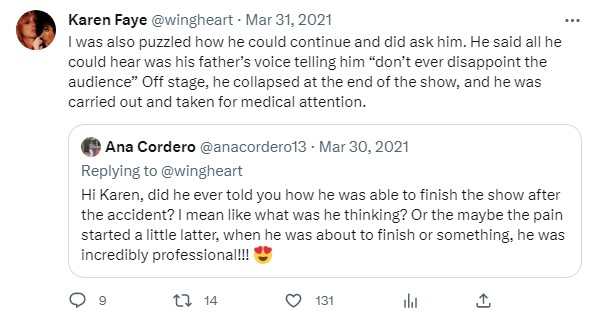
This reminds me of what Karen Faye said about the bridge accident during Earth Song. It was his trauma that made him keep performing and finish the show despite the pain.

Tweet-Karen-Faye749.jpg
 
What I wanted to say about this book is that it underscores the mindfuck environment Michael was in. Yeah he words it carefully but he gives off a good idea of the environment.

That being granted, I would be very anxious if I were to deal with the HIStory marketing campaign, even as a fan. Coming off the allegations, trying to make Thriller happen again, the marriage. That's a lot of things! So I get it would be daunting. The guy is way more sympathetic than it seems and at first he's just trying to convey his feelings at the time and I get the guy was just doing his work but...

Janet, Jermaine were right. There were too many people around him, insane people, people that don't respect him and that mock him, or even cool people who wanted something from him.
It wasn't a professional environment. What was going on with the label execs mimicked what was going on with the tabloids. Plus all these threats about the chaos heading to a train wreck are strangely ominous. It's like they couldn't control him the way they wanted him, it's like he wasn't breathing the right way, so they were always tearing him down in hopes that he could be controlled. And I say this to all the quips "so people at Epic felt this way." It wasn't even only MJ, as Mariah and George Michael felt controlled in an extreme way too.

They looked at him as a product even when the human being was falling apart.

The bit about going back and forth with Michael for the Dangerous Home VHS or the HISTory teaser and the Scream shoot just sounds like poor management. That happens at my work too. And it's poor management. Why are the teams not in tune with each other? Who would be the manager throughout all that? The part with Michael on the editing too, make sure you sit down together with Michael and the producer and the editor before hiring them and nip any issue in the bud. If something happens when the camera's rolling, make sure to sit everyone down again. And remember it's Michael's artistic vision. I get they were on the early stages for this kind of movie-like management on videos but it really does sound like a typical situation I've seen personally. It does sound like they had issue telling Michael no but Michael worked just fine with the studio folk, from Quincy Jones to Teddy Riley to Bruce Swedien. But at the same time they could do the same recoupable charge thing they do to every struggling artist, which I'm sure the label loved.

Didn't know Bad was a disappointment, despite being one of the best selling albums ever globally. Being in the fan community, it was always seen as his creative and career peak. And in ways, it was more exciting than Thriller with all those iconic music videos in droves (Smooth Criminal, Bad, Leave Me Alone, TWYMMF, Liberian Girl). But lately I've come to realize the labels and music critics thought Off the Wall and Thriller were his only 2 good and worthy albums. That's what he says too. So the pressure on Michael after Thriller was just too bizarre.

These points aside, it was a really great insight into next-level marketing. It's incredible to read what goes into planning albums like Bad, Dangerous and HIStory from a marketing standpoint. Again, thank you for the great summary @jasmine.uddin
 
Back
Top