Stevie Wonder

Stevie Wonder will embark on a U.S. tour next month titled "Sing Your Song! As We Fix Our Nation's Broken Heart," leading up to the 2024 presidential election.

The 10-date trek, which gets its name from Wonder's recently released single, kicks off on Oct. 8 in Pittsburgh and concludes on Oct. 30 in Grand Rapids, Michigan. Tickets go on sale Friday.
 
On Jan. 30, two separate concerts will take place in Los Angeles as part of FireAid. Both benefit shows will raise money for rebuilding communities in California that have been affected by the recent wildfires, as well as for helping prevent future natural disasters.

At the Intuit Dome will be Billie Eilish, Earth, Wind & Fire, Gracie Abrams, Jelly Roll, Katy Perry, Lady Gaga, Lil Baby, Olivia Rodrigo, Peso Pluma, Rod Stewart, Stevie Wonder, Sting and Tate McRae. Less than a five minute drive away at the Kia Forum, the lineup will be Alanis Morissette, Anderson. Paak, Dave Matthews and John Mayer, Dawes, Graham Nash, Green Day, John Fogerty, Joni Mitchell, No Doubt, P!nk, Red Hot Chili Peppers, Stephen Stills, Stevie Nicks and the Black Crowes.
 
đŸ„ł đŸ€© ✹ đŸ©·

@NYMaNews

"Today we honor singer-songwriter, musician, and record producer Stevie Wonder on his 75th birthday!"

Gq10wLdWkAAeSW7
 
And just like the previous year, Wonder appeared in front of the stage for a duet with Rush. More details, per a news release:

Rush’s song selections played an unexpected role in the reunion. In 2025, she captured Wonder’s ear with “Until You Come Back to Me.” This year, Rush and her remote band opened with Wonder’s own “So What the Fuss” — a funk-driven call-to-action against global apathy and conflict. Wonder once again paused mid-walk as Rush sang, noticing her not once, but for the second year in a row.

Here’s the 2025 team-up:
 
Last edited:
First post ever. Stevie Wonder singing "they wont go when I go" was the most memorable and teary moment for me during MJ's memorial service. The lyrics, dating from the early 70s, are almost all prophecy for the life Michael would have to lead. The song has stuck with me ever since.

"No more lying friends, wanting tragic ends"

"Unclean minds mislead the pure
The innocent will leave for sure
For them there is a resting place "
 
First post ever. Stevie Wonder singing "they wont go when I go" was the most memorable and teary moment for me during MJ's memorial service. The lyrics, dating from the early 70s, are almost all prophecy for the life Michael would have to lead. The song has stuck with me ever since.

"No more lying friends, wanting tragic ends"

"Unclean minds mislead the pure
The innocent will leave for sure
For them there is a resting place "
That is so prophetic đŸ„șđŸ„ș
By the way, congrats for your first post 👏
 

Top 40 Songs of 1976​

The year before punk broke, rock's old guard made a strong, pressing stand.
But as the UCR staff-selected list below of the Top 40 Songs of 1976 shows, the music that dominated headlines at the end of the decade was starting to make a pass in the fast lane.
You'll find pop, disco, soul, punk, folk and progressive sounds mixed among the rock songs. It was an eclectic year, on the verge of something new and possibly bigger than the guitar-driven rock 'n' roll that steered much of the first half of the '70s. For now, though, familiar names are mostly at the forefront.
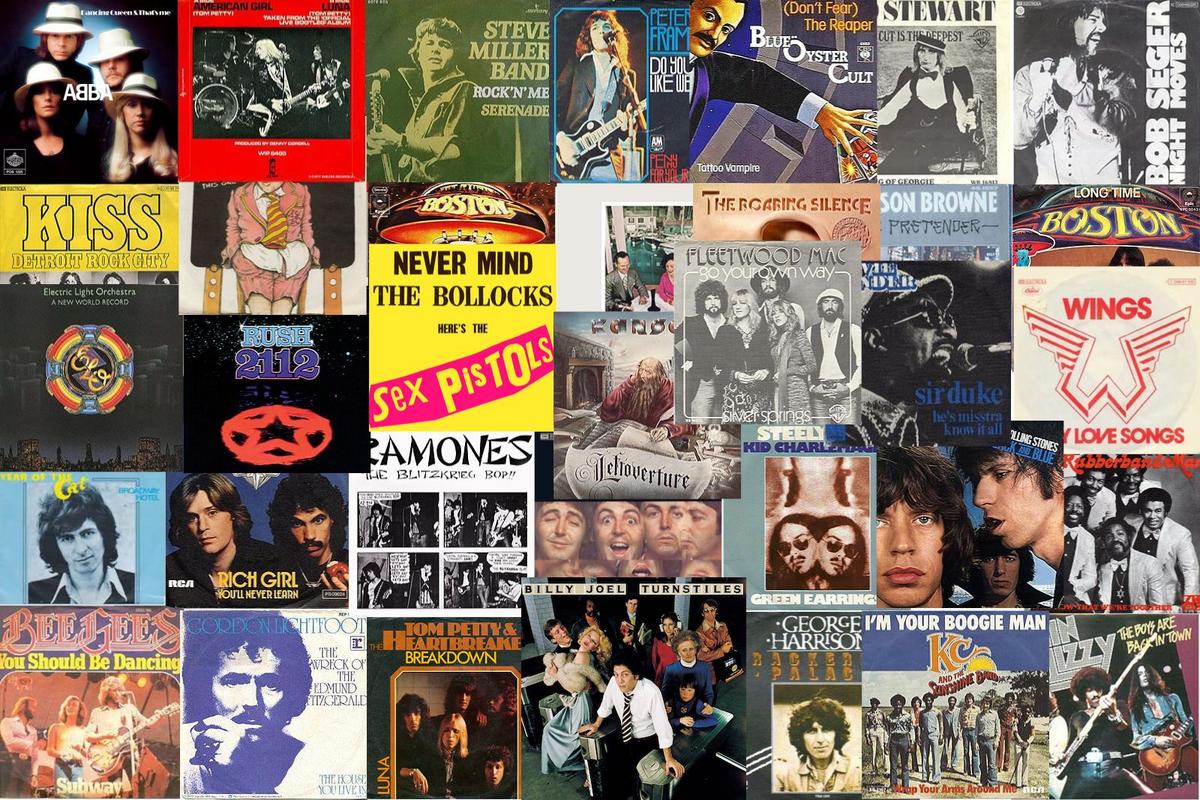
2. Stevie Wonder, "Sir Duke" (From Songs in the Key of Life)
A music legend pays tribute to other legends in one of 1976's most joyful songs. Stevie Wonder's double-LP-plus-EP Songs in the Key of Life was declared a masterpiece from the day of release, and "Sir Duke," the album's second single and second No. 1, gives a history lesson in four glorious pop-soul minutes. Louis Armstrong, Count Basie, Ella Fitzgerald, Glenn Miller and, of course, Duke Ellington are dutifully saluted. Luminous!
 
😜 😘 THE WONDER SIGHTINGS:
@DJ Jazzy Jeff
Shared with Public
DJ Jazzy Jeff · Original audio
Running into Stevie still gets me every time
 đŸ€Ż
What’s your favorite Stevie Wonder song?
Today mine is “That Girl” because I love so many!
 
đŸ„č 😘 đŸ€Ș đŸŽ¶ Lady Gaga - I Wish (Live at Stevie Wonder's GRAMMY Salute / 2015)
Quote:
“I haven’t shared this with anyone,” Lady Gaga told Stevie Wonder at his Grammy Salute, before telling the soul icon that when she was six years old, “Your album was the first CD that I ever took myself and put it in the CD player, and you truly are the reason that I’m here today.”
Gaga then dropped what fans consider one of her greatest performances on a legendary Stevie hit from ‘76.
We all know Gaga’s dance bangers, but you might just be bowled over by hearing her husky soul power on this iconic singalong chorus!
You can really see that Gaga’s sweet tribute meant so much to Stevie!
 
Last edited:
THE 2015 STEVIE WONDER GRAMMY TRIBUTE TO THE SONGS IN THE KEY OFF LIFE! (FULL SHOW)

The Star Studded Set List:
Beyonce, Ed Sheeran, Gary Clark - 00:33
John Legend - 11:17
Lady Gaga - 16:51
Documentary - 20:36
Ariana & Babyface - 24:09
Annie Lennox - 28:05
Pharrel William - 32:25
Tony Bennet - 35:26
Ed Sheeran - 39:16
Band Perry - 44:28
India Ari - 48:52
Andrea Bocelli - 53:50
Jennifer Huston - 57:00
Neo - 1:02:21
Stevie - 1:06:08
Stevie - 1:08:08
Stevie - 1:16:16
Stevie - 1:25:00
 
Last edited:
đŸ„č 😘 đŸ€Ș đŸŽ¶ Lady Gaga - I Wish (Live at Stevie Wonder's GRAMMY Salute / 2015)
Quote:
“I haven’t shared this with anyone,” Lady Gaga told Stevie Wonder at his Grammy Salute, before telling the soul icon that when she was six years old, “Your album was the first CD that I ever took myself and put it in the CD player, and you truly are the reason that I’m here today.”
Gaga then dropped what fans consider one of her greatest performances on a legendary Stevie hit from ‘76.
We all know Gaga’s dance bangers, but you might just be bowled over by hearing her husky soul power on this iconic singalong chorus!
You can really see that Gaga’s sweet tribute meant so much to Stevie!
Oh my goodness! So good!
 
đŸ„č 😘 đŸ€Ș đŸŽ¶ Lady Gaga - I Wish (Live at Stevie Wonder's GRAMMY Salute / 2015)
Quote:
“I haven’t shared this with anyone,” Lady Gaga told Stevie Wonder at his Grammy Salute, before telling the soul icon that when she was six years old, “Your album was the first CD that I ever took myself and put it in the CD player, and you truly are the reason that I’m here today.”
Gaga then dropped what fans consider one of her greatest performances on a legendary Stevie hit from ‘76.
We all know Gaga’s dance bangers, but you might just be bowled over by hearing her husky soul power on this iconic singalong chorus!
You can really see that Gaga’s sweet tribute meant so much to Stevie!
That was an awesome performance of Gaga.
 
Steve & Stevie - The "I Wish" Parody Remix
(Live Duet)
I had a great time with Stevie Wonder I think I might have had a career singing đŸ€ŁđŸ˜đŸ˜‚
Didn't no onesay nothing about Steve not knowing the words at all??
And Stevie was a gangsta with a cane, for real!! :cool: 👑:LOL:
#TBT #shameful
 
662529577_1288811273345249_2310817700149590723_n.jpg

The African American History Article:

They paid Stevie Wonder $2.50 a week while he made Motown millions.
By the time he turned 21, he had earned the label an estimated $30 million.
When the trust finally opened, he got about $1 million of it back.
So he walked.

And before he ever returned, he made sure the next contract would sound nothing like childhood.
Stevland Hardaway Morris was only eleven when Motown signed him. Blind, brilliant, and already overflowing with music, he entered Hitsville U.S.A. as a child prodigy with a harmonica in his hand and a universe in his head. The company gave him a weekly allowance of two dollars and fifty cents. His mother, Lula Mae Hardaway, received two hundred dollars a month. Everything else the boy earned was locked away in a trust fund controlled by the label until he came of age. That arrangement may have looked respectable on paper. In reality, it meant a child was generating enormous wealth while living on pocket change.
And Stevie understood more than the adults around him realized.

Years later, still a boy, he picked up the phone at Motown, lowered his voice into a dead-perfect imitation of Berry Gordy, and called Gordy’s own secretary. He instructed her to cut Stevie Wonder a check for fifty thousand dollars. She nearly did it.
The prank was funny. But it was also revealing.
Somewhere inside the joke was a truth too heavy for the room: this child already knew who had power, who controlled the money, and how absurd the whole arrangement really was.

His mother had taught him what survival looked like long before fame arrived. Lula Mae Hardaway came from Alabama, from a world shaped by poverty, instability, and violence. She married a man decades older who drank, gambled, and abused her. When Stevland was born prematurely in Saginaw, Michigan, on May 13, 1950, too much oxygen in the incubator damaged his eyes, leaving him permanently blind within weeks.
His father offered little tenderness and less support. The violence at home worsened. In 1954, after years of trying to endure it, Lula fled with her children to Detroit, carrying whatever money she had managed to hide away.
She cleaned houses. She worked whatever jobs she could. She kept food on the table. She kept her children moving forward.
And her son kept listening.

By five, Stevie was teaching himself piano and harmonica. By eight, he had added drums. At church, his voice rose in solo after solo. On Detroit street corners, he and a friend named John performed together for anybody willing to stop and hear them.
What people noticed first was the talent. What they learned later was the mind behind it.
Stevie was mischievous, fearless, and constantly playing with sound. He memorized voices, rhythms, footsteps, habits. At Motown, he turned the building into his playground. He could unsettle grown adults with a joke, imitate voices with eerie precision, and make people laugh before they realized how closely he had been studying them all along.

That energy caught the attention of Ronnie White of the Miracles, who helped bring Stevie and his mother to Motown in 1961. Berry Gordy may not have been fully sold on the singing at first, but the harmonica changed everything. The label signed him, paired him with producer Clarence Paul, and gave him the name that would become legendary: Little Stevie Wonder.
Then came the explosion.

In 1963, during a Motortown Revue performance at Chicago’s Regal Theater, twelve-year-old Stevie launched into “Fingertips,” a live performance so electric it felt like the room might lift off the ground. The crowd roared for more. The recording—especially “Fingertips, Pt. 2”—shot to number one on the Billboard Hot 100.

At thirteen, Stevie Wonder became the youngest solo artist ever to top the pop chart.
For a moment, he was a sensation.
Then adolescence hit. His voice changed. The novelty wore off for some executives. A few at Motown were ready to move on. But Stevie was not done becoming himself. Songwriter and producer Sylvia Moy fought for him, and she was right to do it.
He returned not as a novelty, but as an artist.
In 1965, he helped write “Uptight (Everything’s Alright),” and the comeback was on. Then came “I Was Made to Love Her.” Then “For Once in My Life.” Then “My Cherie Amour.” In 1970, “Signed, Sealed, Delivered I’m Yours” arrived from the first album he produced himself, with songwriting help from the woman who had carried him into that future—his mother. The hits kept coming.
So did the pranks.

In 1968, he released an instrumental album under the name Eivets Rednow—his own name spelled backward—with no mention of Stevie Wonder anywhere on the cover. It was playful, yes. But it was also something deeper: a young artist testing how much of his genius could exist outside the identity the label had built around him.
By then, he had spent nearly a decade inside a machine that profited enormously from his gifts. He understood the arrangement better with every passing year.

On May 13, 1971, Stevie turned twenty-one.
Berry Gordy threw him a lavish birthday party. The next morning, Gordy received a letter from a lawyer formally severing Stevie’s Motown contracts. He was blindsided.
Stevie may have felt uneasy about how abruptly it happened. He even dismissed that lawyer not long after. But the essential point remained: the child had become a man, and the man was done asking for permission.
When his trust fund was finally opened, it held roughly one million dollars.
By then, Stevie had reportedly generated around thirty million for the label.
That was the math.
That was the lesson.

So he did what artists rarely get to do at exactly the right moment: he left.
With his trust money, he booked studio time in New York and began building a new sound on his own terms. At Electric Lady Studios, he connected with Malcolm Cecil and Bob Margouleff and their massive synthesizer system, TONTO. Together, they opened a new world.
What followed was one of the greatest creative runs in modern music.
Music of My Mind.
Talking Book.
Innervisions.
Fulfillingness’ First Finale.
These were not just successful albums. They were declarations of independence. Stevie wrote, produced, arranged, experimented, and pushed beyond the boundaries Motown had once set for him. He stopped sounding like a product of the system and started sounding like a force that had outgrown it.
Then Motown came back to the table.

But this time, Stevie Wonder was not the child on an allowance.
He demanded full creative control. He demanded ownership over his publishing through Black Bull Music. He demanded a royalty rate no Motown artist had ever secured. And in 1975, the label agreed to a seven-year, seven-album deal worth $13 million upfront, with the total value potentially climbing far higher.
He had walked away with one million.

He returned on his own terms for thirteen times that before the next note was even sung.
And because Stevie was still Stevie, he reportedly showed up to the signing celebration dressed like a Black cowboy hero—hat, fringe, swagger, and a holster stamped with the words: “Number One With a Bullet.”
That wasn’t just style.
That was the punchline.
Because the prank had never really been the joke.
The prank was the evidence.

Evidence that the boy who could imitate the boss’s voice at twelve understood power earlier than anyone imagined. Evidence that the child living on pennies was studying the people living off his brilliance. Evidence that behind the laughter was a mind taking notes, learning the room, and waiting for the day it could no longer be managed.
Stevie Wonder would go on to become one of the most important artists in American history. He sold more than 100 million records. He won 25 Grammy Awards. He helped lead the campaign to make Martin Luther King Jr.’s birthday a federal holiday. He used his voice in the struggle against apartheid, hunger, and injustice.

But before all of that, he was a blind Black child in a building full of adults who controlled his money, his music, and even his name.
And one day, he asked for what he was worth in the boss’s own voice.
They laughed then.
Later, they paid.
 

50 Greatest Solo Artists in Rock History

6. Stevie Wonder

A child prodigy turned international superstar, Stevie Wonder always seemed destined for musical greatness. He scored his first No. 1 song, “Fingertips,” when he was just 13 years old. The hits would come even faster once he hit adulthood. "Uptight (Everything's Alright),” “For Once in My Life,” “Superstition” and “Higher Ground.” Wonder’s penchant for crafting engrossing songs has only been exceeded by his incredible performing ability. Piano, clavinet, harpsichord, harmonica, drums, percussion – he is a virtuoso in every sense of the word.
 
Last edited:
Back
Top