The Statues Return to Neverland ~ by Larry Nimmer
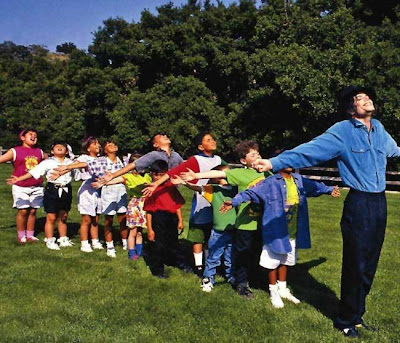
(Photo Above: taken a few weeks ago at Neverland, showing one of the Kid sculptures had returned, with wildflowers around it,
the shot was taken from the golf cart, driving by the frolicking mike-like kids.)
Interestingly, if this is true, now follow my logic and you could make another interesting DVD-Movie about this statue.
The statue I mention which I think is the inspiration for the one at Neverland is probably modeled on modeled on Barmaley Fountain in Stalingrad.
Now the original statue shows a crocodile and this is in reference to Korney Chukovsky's fairy tale poem about Doctor Aybolit and his antagonist, the evil pirate Barmaley, became an archetypal villain in Russian culture. Think here of the CONNECTION between Peter Pan and Captain Hook, the villainous pirate captain who is also the antagonist of and lord of the pirate village/harbour in Neverland. Now Captain Hook in J. M. Barrie's play Peter Pan meets his demise when a crocodile eats him.
Doctor Aybolit Korney Chukovsky's fairytale also asked a crocodile brought in by a gorilla to swallow up Barmaley, the evil pirate so that he could no longer harm little children. The crocodile swallowed the gorilla, but Barmaley was later released after promising to change. Barmaley became nicer and proclaimed he would be kinder, that he now loved little children and would become a friendly baker.
Peter Pan; or, the Boy Who Wouldn't Grow Up was published in 1904 and Korney Chukovsky's fairytales around the same time. His poems, Doctor Aybolit, The Giant Roach, The Crocodile have been favourites with many generations of Russophone children.
Like Peter Pan The poems found their following in the films Doktor Aybolit (black and white, 1938), Aybolit 66 (Mosfilm, 1967, English title: Oh How It Hurts 66), and Doctor Aybolit (animated film, Kievnauchfilm, 1985).
INTERESTINGLY, the actual origins of Aybolit can be traced to Doctor Dolittle by Hugh Lofting.
Now the Stalingrad memorial contains an original allegory, which is derived directly from the eponymous Russian fairy tale poem and says
'Little children! / For nothing in the world / Do not go to Africa / Do not go to Africa for a walk! // In Africa, there are sharks, / In Africa, there are gorillas, / In Africa, there are large / Evil crocodiles / They will bite you, / Beat and offend you - // Don't you go, children, / to Africa for a walk / In Africa, there is a robber, / In Africa, there is a villain, / In Africa, there is terrible / Bahr-mah-ley! // He runs about Africa / And eats children - / Nasty, vicious, greedy Barmaley!..
This would be so interesting as Michael loved Africa so much and may have been aware of the hidden meaning.behind the statue.
The Barmaley was a fountain in the city of Stalingrad,
installed in front of the Museum of Defense of Tsaritsyn.
Its official name was Children's Khorovod.
The statue was of a circle of six children dancing around a crocodile. It was made famous by several photographs by Emmanuil Evzerikhin that juxtaposed the carnage of the Battle of Stalingrad with the banality of children at play. The fountain was restored after World War II, but was later removed in the 1950s. The statue featured prominently in Enemy at the Gates, and a similar statue was seen in V for Vendetta. It is also seen in the film A Clockwork Orange, in the documentary footage shown to the main character Alex as part of the sinister aversion therapy to "cure" him of "ultra-violence."
The Back Story
The allegory of the monument was derived from the eponymous fairy tale poem written by Korney Chukovsky. While being burned in fire by Barmaley, Doctor Aybolit asked a crocodile brought in by a gorilla to swallow up Barmaley, so that he could no longer harm little children. The crocodile did so, but Barmaley was later released after promising to change. Barmaley became nicer and proclaimed he would be kinder, that he now loved little children and would become a friendly baker.
The Source:
Larry Nimmer FB Page









 Thank you so much


